
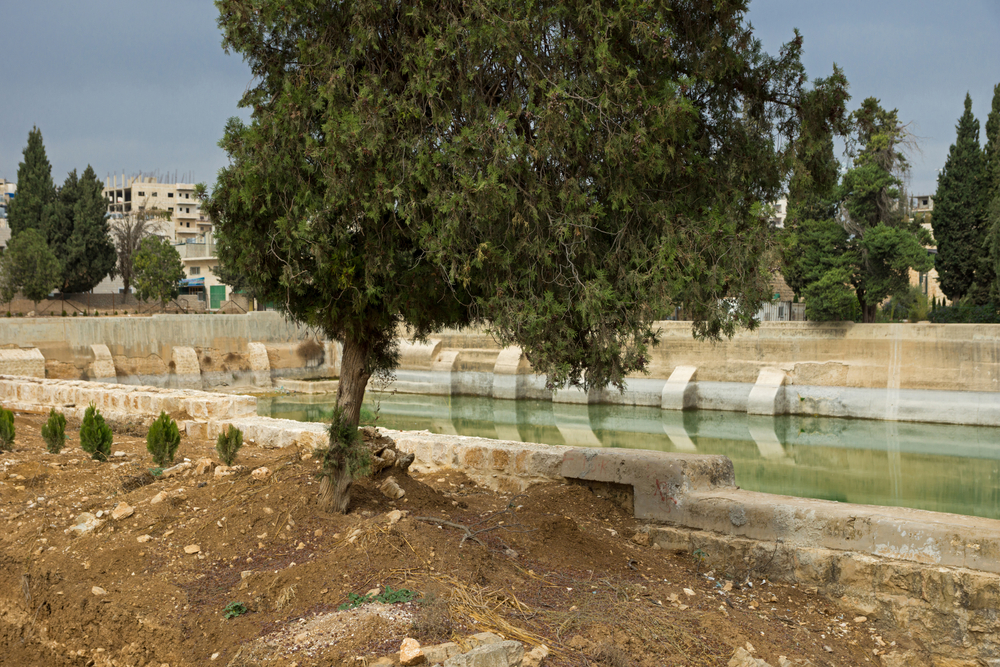
A construction crew working near Jerusalem just uncovered a two thousand year old water system.
That system carried water thirteen miles across hills and valleys using nothing but gravity.
What ancient engineers built into that channel is still astonishing the archaeologists excavating it today.
A 13 Mile Water Highway Powered By Nothing but Gravity
The Israel Antiquities Authority has exposed a 300 meter stretch of Jerusalem's Lower Aqueduct near Kibbutz Ramat Rachel, south of the Old City.
The full aqueduct ran roughly 13 miles from Solomon's Pools, near Bethlehem – overlooking the West Bank – all the way into Jerusalem.
Along most of that route, the water dropped only about one meter in elevation for every kilometer it traveled.
There were no pumps, no machinery, and no modern surveying equipment involved. Gravity alone moved the water the entire distance.
Excavation directors Benyamin Storchan and Gil Freid put it simply: "The system was so well planned that it remained in intermittent use until about 100 years ago."
Built for Kings, Used Until a Century Ago
Archaeologists believe the aqueduct dates to the Hasmonean kings, the dynasty that ruled Judea before Rome took control of the region.
Its job was to move spring water from the Gush Etzion region to the Temple Mount, routed through the reservoirs at Solomon's Pools.
The builders even included access points along the route so crews could climb in and clear blockages without shutting the whole system down.
About 500 years ago, during the Ottoman period, engineers ran ceramic pipes inside the original channel and plastered its outer walls.
Amit Re'em, the IAA's Jerusalem district archaeologist, put the scale of the achievement plainly: "The thought that about 2,000 years ago they managed to bring water to Jerusalem this way is astonishing."
The discovery came up during routine infrastructure work, the same way so many of Jerusalem's ancient secrets have surfaced over the decades.
The Fancier Aqueduct Lost to the Simpler One
Jerusalem actually ran two of these systems at once in ancient times. The Upper Aqueduct was the more technologically advanced build, and it carried water to the elites living in the upper city.
The Lower Aqueduct, the one just uncovered near Ramat Rachel, was the simpler design of the two, and that simplicity is exactly what let it outlast its fancier counterpart by roughly a thousand years.
Its builders had no bridges or arches to lean on, unlike the aqueducts Roman engineers built around the same era in Caesarea and across Italy. Where a hill stood in the way, they cut tunnels straight through the mountain rather than lose the gradient on a detour.
Archaeologists have only excavated about 2 kilometers of the aqueduct's full 21 kilometer route so far, which means most of what this system still has to show is sitting underground, waiting on the next construction crew to find it.
Why a Water Channel Still Humbles Modern Engineers
This is not the first time construction crews have stumbled onto pieces of the same system. Sections of Jerusalem's Lower Aqueduct have surfaced periodically for more than a decade as new building projects pushed into the hills south of the Old City, with each discovery adding another stretch to a system archaeologists are still piecing together one construction permit at a time.
Modern water systems lean on pumps, pressure valves, and computer modeling just to move water a fraction of that 13 mile distance.
The Hasmonean era builders had none of that, and still hit a grade so consistent that two millennia of wear barely moved the needle on how well it worked.
The Israel Land Authority and the IAA now plan to preserve the exposed aqueduct and build it directly into the entrance of a new neighborhood expected to carry up to 1,800 housing units, linking Ramat Rachel with Giv'at HaMatos and Har Homa.
The IAA has also floated turning the full stretch, from southern Jerusalem into the Old City, into a public park people can walk the same route the water once traveled.
A water system built under kings whose names most Americans never learned in school just outlasted a century of modern construction without anyone even noticing it was still running underneath them.
Sources:
- Israel National News staff, "A Long Section of Jerusalem's 2000 Year Old Lower Aqueduct of Jerusalem Uncovered," Israel National News, October 2026.
- Rossella Tercatin, "2000 Year Old Hasmonean Aqueduct Section Uncovered in Jerusalem," The Jerusalem Post, October 2026.
- Times of Israel staff, "Plans for New Jerusalem Neighborhood Uncover 300 Meter Stretch of Ancient Aqueduct," The Times of Israel, October 2026.
Related posts:
 A Capitol Police Officer Pocketed a Secret Mint Penny and the Government Wants It Back
 DeSantis Joined a Growing Republican Revolt Against Silicon Valley’s Anti-Religious AI Religious Pitch
 A South Dakota Family That Saved the Buffalo Is Landing On Your Pocket Change