Every Sunday school kid in America learned that the Ark came to rest on the mountains of Ararat.
A team drilling into a boat-shaped mound near Mount Ararat just went deeper than anyone before them.
What the drill failed to find matters even more than the layer that broke it.
What the Drill Hit Beneath the Boat-Shaped Mound
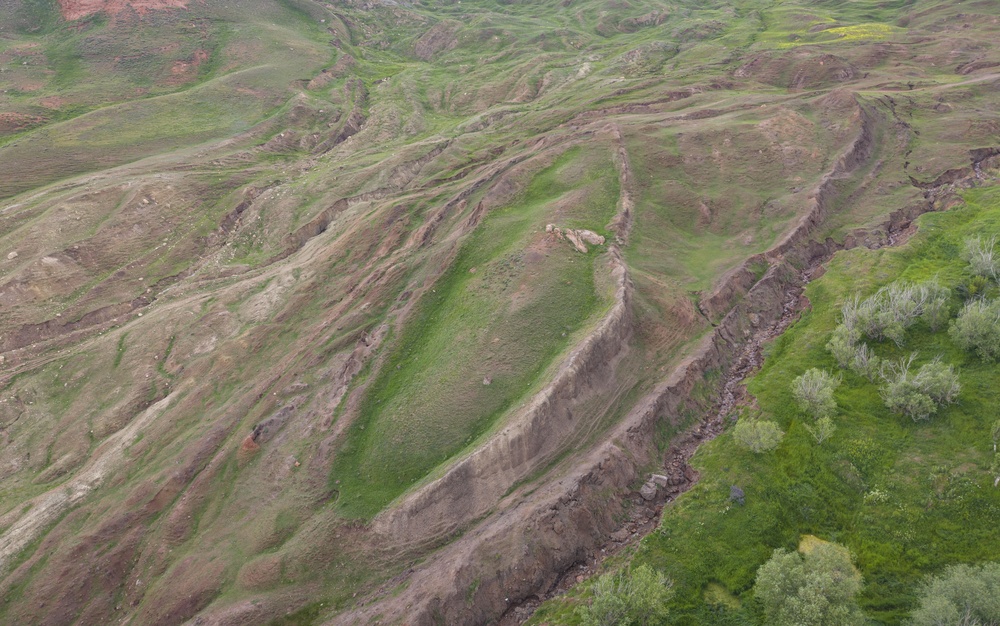
The site is called Durupınar, tucked into the hills of eastern Turkey.
From the air it looks like the outline of a giant ship pressed into the hillside.
In September 2026, crews from the Noah's Ark Research Project began core drilling inside that outline.
Roughly 13 to 16 feet down, the bit hit something it could not handle.
"Whatever the core drill struck was harder than limestone – hard enough to break the bit," said Andrew Jones, the project's vice president and founder of Noah's Ark Scans.
The team's working theory is petrified or heavily mineralized wood.
This is no backyard treasure hunt.
Turkish archaeologist Cenker Atila leads the expedition, Ağrı İbrahim Çeçen University backs the project, and Sivas Cumhuriyet University is part of the drilling team.
By the end of the season, the team had bored past the 60-foot mark – a depth nobody had reached at this site.
More than 300 bags of soil came up, some from inside the boat shape and some from the ground around it.
And the thing skeptics always said was down there never showed up.
"We did not encounter any solid block of rock," Jones told Fox News Digital.
No continuous limestone layer.
Mostly soil, scattered boulders, organic-rich sediment, and one underground cavity that kept filling with water while the drill ran.
The Rock Formation Verdict Facing Its Toughest Test Yet
The skeptics settled this case a long time ago.
In 1959, a Turkish Army captain named İlhan Durupınar photographed the shape from the air during a NATO mapping flight.
The 1960 team that followed dug for two days, found no visible remains, and wrote it off as a freak of nature.
Ron Wyatt revived the site in the late 1970s, and a 1985 radar survey measured the formation at about 538 feet – right in the neighborhood of the 300 cubits Genesis gives for the Ark.
Geologists answered that the whole thing was a natural stone formation, and a 1996 study dismissed the Ark claims outright.
A 1988 drilling attempt went shallow, and the cooling water used during the dig contaminated the cores.
So the argument stalled at the surface.
Then the dirt started talking.
Soil samples pulled in 2024 showed three times more organic matter inside the formation than outside it.
Potassium – a marker associated with wood ash – ran 38 percent higher inside.
The pH gap between inside and outside was eightfold.
Jones called the differences "statistically staggering."
His read is a closed system, where biological material broke down over time and permanently changed the soil chemistry around it.
Numbers like that demand a drill, not a shovel.
Ancient pottery turned up nearby too, tentatively dated from the Copper Age through the Iron Age, though Jones is careful to note it was found beside the formation, not inside it.
Now 300 fresh samples are headed for testing, and the team is hunting for any sign of human activity or decayed wood.
Why 300 Soil Samples Put the Experts on the Clock
Genesis 8:4 puts the Ark "upon the mountains of Ararat."
Not one mountain.
The mountains – plural – a whole range, exactly where this mound sits.
The credentialed crowd treated anyone who took Durupınar seriously like a crank.
They said rock.
The drill never found it.
If the lab finds wood fibers in those cores, the textbooks get rewritten.
If it finds mineralized timber in the layer that broke the bit, the 1960 verdict is finished.
Jones is not declaring victory, and the team says there is more lab work ahead before anybody draws conclusions.
That is the right call.
But the people who closed this case in 1960 dug for two days and went home.
This team went 60 feet down.
And whatever broke that bit is about to get its day in a laboratory.
Sources:
- Andrea Margolis, "Researchers of Noah's Ark Project Drill 60 Feet, Find No Rock at Turkey Site," Fox News, October 2, 2026.
- Andrea Margolis, "Potential Noah's Ark Site in Turkey Debated After New Soil Data Research," Fox News, June 6, 2026.
- Noah's Ark Scans, "Core Drilling Begins at Durupinar Noah's Ark Site, Drill Bit Shatters on Possible Layer of Petrified Wood," GlobeNewswire, September 23, 2026.
Related posts:

 New Mexico Governor Turned Trump’s New America Map Into a Campaign Speech
 Trump Used One Word to Describe What Charlie Kirk Became a Year After His Assassination
 Jon Ossoff Blasted the Epstein Class But it Turns Out He Personally Pocketing Its Money