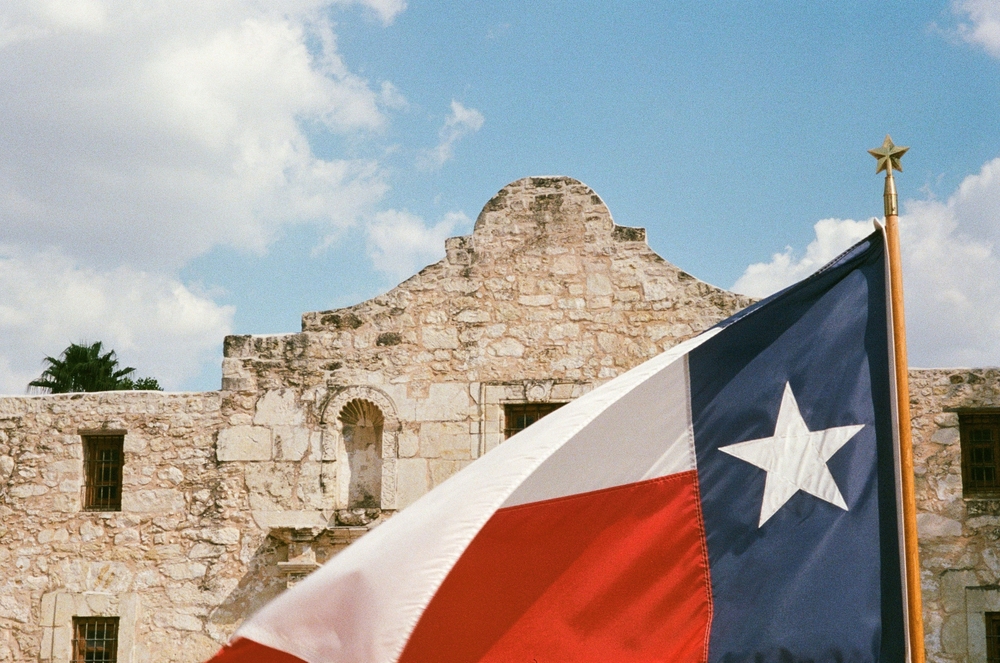
Three feet under the dirt outside the Alamo Church, archaeologists pulled out four cannonballs that had been sitting there since the siege that killed Davy Crockett.
Before this dig, nobody could point to a single solid cannonball ever recovered from the most sacred ground in Texas.
Now the metal is pointing straight at Santa Anna's guns – and possibly at a desperate move inside the walls.
Three of the Four Cannonballs Are Mexican Army Bronze
The Alamo Trust revealed the last two finds in late October, wrapping up an 18-month dig around the edges of the old mission church.
The first ball came up on March 5, 2026 – one day shy of the 190th anniversary of the final assault.
A second followed in June, and the last two turned up before the crews packed it in this fall.
All four sat just off the church's northeast corner, roughly two and a half to three feet down.
One is iron and fits a 6-pounder cannon.
The other three are bronze – a 1-pounder, a 4-pounder, and a 6-pounder.
Alamo Trust historians say bronze shot was typically Mexican army issue, while iron is tied to the Texan side.
"They may have originated with the Mexican army," said Dr. Tiffany Lindley, the Alamo's director of archaeology.
Historians on her team place the spot near a Mexican cannon position just outside the walls.
"They would have been shooting toward the church in this area," Lindley said.
That matches the history of the siege, when Santa Anna's gunners hammered the fort from a battery set up off its northeast side.
The Defenders May Have Fired Santa Anna's Own Rounds Back
Lindley admits the full answer is complicated.
She says the bronze balls could also have ended up in the hands of the defenders or others before the battle ever started.
That isn't far-fetched.
Less than three months before Santa Anna arrived, Texian volunteers stormed San Antonio and forced Mexican Gen. Martín Perfecto de Cos to surrender.
Within days, his garrison marched out of the Alamo and headed south.
So some of that Mexican bronze may have been sitting inside the walls when roughly 200 men loaded up and aimed it back at the army that made it.
The Soil Layer Ties Every Ball to the 13-Day Siege
What isn't complicated is when these cannonballs hit the ground.
They came out of the same layer of earth as musket balls and gun parts, buried deeper than the newer artifacts above them.
The first ball sat next to four fragments of exploding howitzer shells – three bronze and one iron – in soil that dates to the siege.
All told, the team figures it hauled up somewhere between 500,000 and 750,000 objects, from a tea kettle and spoons to old bottles.
None of it hits like a cannonball fired into the compound where Crockett, William Travis, and Jim Bowie made their stand.
"Now we have a physical piece of evidence of the sacrifice," Lindley said.
The Forget the Alamo Crowd Just Lost the Argument
The Mexican army closed around the old mission on February 23, 1836, and the men inside held out for 13 days.
At dawn on March 6, Santa Anna's troops broke through, and almost none of the defenders survived.
Six weeks later, Sam Houston's army charged at San Jacinto screaming "Remember the Alamo" and routed Santa Anna in less than 20 minutes.
That story was good enough for Texans for nearly two centuries.
Then in 2021, authors Bryan Burrough, Jason Stanford, and Chris Tomlinson published a book with a title that said it all – "Forget the Alamo."
They picked apart the backgrounds of Bowie and Travis and put slavery at the center of the fight for Texas independence.
When the state history museum in Austin scheduled an event to promote it, Lt. Gov. Dan Patrick shut it down.
"As a member of the Preservation Board, I told staff to cancel this event as soon as I found out about it," Patrick wrote.
The authors and their publisher cried censorship.
Now the ground itself has answered.
You can argue with a book.
You can't argue with a 6-pound ball of bronze dug out of the dirt where those men chose to die rather than surrender.
The Alamo Trust is still sorting through everything that came out of that dig, and the new Alamo museum under construction is going to have plenty to put behind the glass.
Every piece they display is one more reason nobody is going to forget the Alamo.
Sources:
- Andrea Margolis, "Cannonballs unearthed at Alamo nearly 200 years after deadly siege, yet mystery remains," Fox News, November 6, 2026.
- Kieran Sullivan, "Archaeologists uncover nearly 200-year-old cannonballs from the Battle of the Alamo," FOX Weather, November 7, 2026.
- Andrea Margolis, "Cannonball 'very likely' fired in 1836 Battle of the Alamo found buried near church," Fox News, April 3, 2026.
- Abby Livingston and Isabella Zou, "Authors say Texas state museum canceled book event examining slavery's role in Battle of the Alamo," FOX 4 News Dallas-Fort Worth, July 2, 2021.
- Joseph Musso, "Battle of Béxar," American Battlefield Trust.
Related posts:
 A Metal Detectorist Near Downton Abbey Found Gold the British Museum Now Calls Treasure
 Cookbook Author Just Exposed the Surprising Reason Your Grocery Bill Keeps Climbing
 Two Helicopters Collided Landing on One Everest Helipad and Nepal Already Knew the Danger