
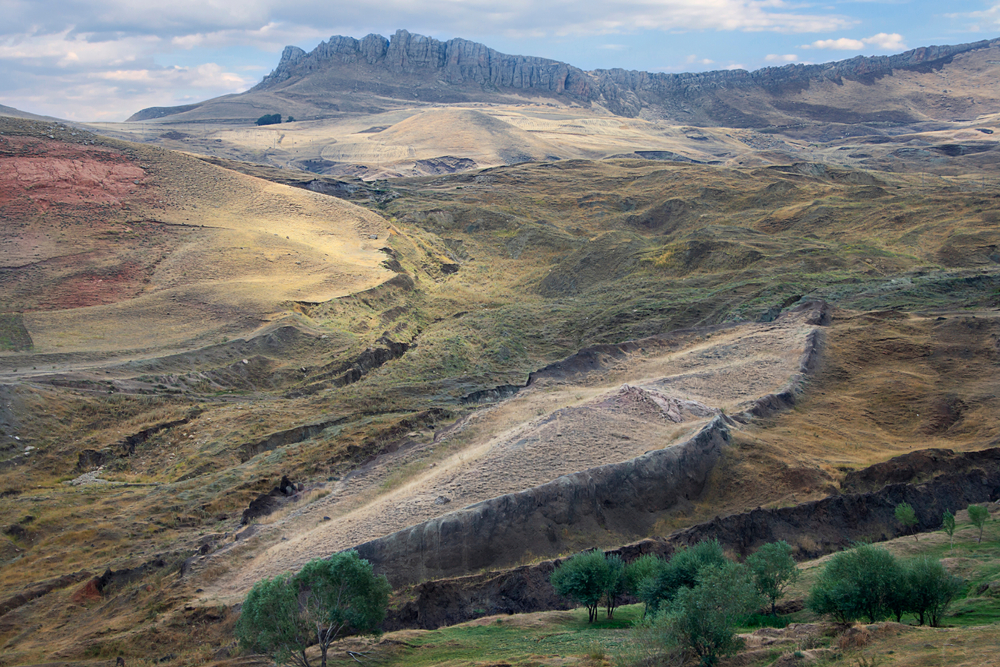
Skeptics have mocked the search for Noah's Ark at a Turkish mountain for decades
Now a university archaeologist just pulled burned wood out of the ground that silenced the laughter
A tenured professor just staked his reputation on a find skeptics have mocked for decades
A Professor Who Studies Ancient Sites Calls the Wood Very Ancient
Cenker Atila is not a pastor.
He is a professor of archaeology at Sivas Cumhuriyet University in Turkey, and he is the one running the dig.
Atila's team recovered charred wood fragments roughly 30 feet below the surface of the Durupınar formation, a boat-shaped rock structure near Mount Ararat that believers have pointed to for more than sixty years.
He called the fragments "very ancient" in his professional opinion.
That single sentence is why Fox News Digital is now sitting on exclusive photos and video from a site most of the mainstream press still treats as a punchline.
The dig used deep-core drilling for the first time at this location, reaching more than 60 feet down in some spots.
Researchers have also pulled more than 300 soil samples from inside and outside the formation over roughly a year of work.
Ground-penetrating radar run by scientist Khosrow Bakhtar reported organized patterns underground, including what looked like chambers and corridors beneath the roughly 515-foot formation.
Atila says the structure appears to have three levels, matching the description of the Ark in the biblical account.
He also says carbon content inside the formation runs higher than the soil outside it.
The wood itself is now sitting in four separate labs in four different countries, each running carbon-14 dating and species identification.
Andrew Jones, the lead researcher with Noah's Ark Scans, put it bluntly: his team has "a lot of work to do."
Jones has said plainly that he is a Christian who believes the biblical account, and he is not pretending otherwise to chase a headline.
Lauren Witzke, director of marketing and fundraising for Noah's Ark Scans, called the discovery "world-shaking" and said it proves the formation is more than just a geological curiosity.
The 1996 Study That Says the Ark Site Is Just a Landslide
The Durupınar site has been a punching bag for professional skeptics since a Turkish army captain first spotted its boat-like outline in aerial photos in 1959.
A 1960 expedition concluded the formation showed "no sign that the object was man made."
Researcher David Franklin Fasold once argued in a 1988 book that the formation really was the Ark, before reversing himself in a 1996 paper co-written with geologist Lorence Gene Collins, concluding it was nothing more than a natural rock structure.
Turkish geologist Murat Avcı goes further still, calling the whole formation an ordinary limestone block pushed downhill by an ancient landslide and worn into shape by weather ever since.
Avcı says the famous "petrified wood" is just ordinary rock, and the "iron brackets" once held up as evidence are actually weathered volcanic material.
Wesley Huff, a biblical apologist, piled on too, calling the current team's work "hobbyist speculation" because no one running the dig holds a formal archaeology credential outside Atila himself.
Huff also argues nobody can even prove today's Mount Ararat is the peak described in Genesis, since the name was only attached to this particular mountain starting in the 13th century.
Noah's Ark Scans fired back that the team has no ties to the late Ron Wyatt, a figure Huff himself dismisses as a fraud.
The team also said its scans show "perfect right angles" and chambers that a random landslide does not produce on its own.
Witzke doesn't dodge the scrutiny either, pointing to independent lab testing, a documented chain of custody, and sign-off from Turkish government overseers as proof this dig is nothing like the viral claims that came before it.
https://twitter.com/BrightInsight6/status/2120242925913375046
What Four Labs in Four Countries Are About to Prove or Kill
A university professor just put his name on the word "ancient" next to a rock formation the academic establishment has dismissed as landslide debris since 1996.
That is not nothing.
Every prior round of Durupınar hype has leaned on grainy radar images and the word of enthusiasts with no letters after their name.
This round has carbon-14 testing running in four countries at once, and the results are not something a university professor can spin after the fact.
If the wood comes back dated to a few thousand years before Christ, the same outlets that laughed off the Ark search for decades will have to print the number.
If it comes back modern or misidentified, Atila's own name and university will be the ones answering for it, not just a crowdfunded ministry.
That is the part skeptics conveniently leave out when they reach for the word "hobbyist": a tenured Turkish archaeologist put his career on the line for this site, and he does not get to hide behind a pseudonym on social media if the lab results embarrass him.
The team hopes to resume full excavation in 2027, after Atila applies for new permits once the lab results are in hand.
Results will post at NoahsArkScans.com as they come in, win or lose.
Sources:
- Andrea Margolis, "Noah's Ark Site Yields First Look at Charred Wood Fragments Recovered Deep Below Soil," Fox News, November 10, 2026.
- Eric Vanden Eykel, "Why People Keep Looking for Noah's Ark in Turkey," Religion Unplugged, October 7, 2026.
- Stephanie Martin, "New Noah's Ark Discovery Is Not Legit, Says Apologist Wesley Huff," Church Leaders, April 24, 2026.
Related posts:

 RFK’s Granddaughter Beat Her Father’s Boston Marathon Time and the Kennedy Curse Still Found Her
 Melania Trump Pulled Off What Years of Peace Talks Never Could in One Ukrainian City
 Alito Serves Colorado a Brutal Reminder in Catholic Preschool Punishment Case About Why It Keeps Losing at SCOTUS