
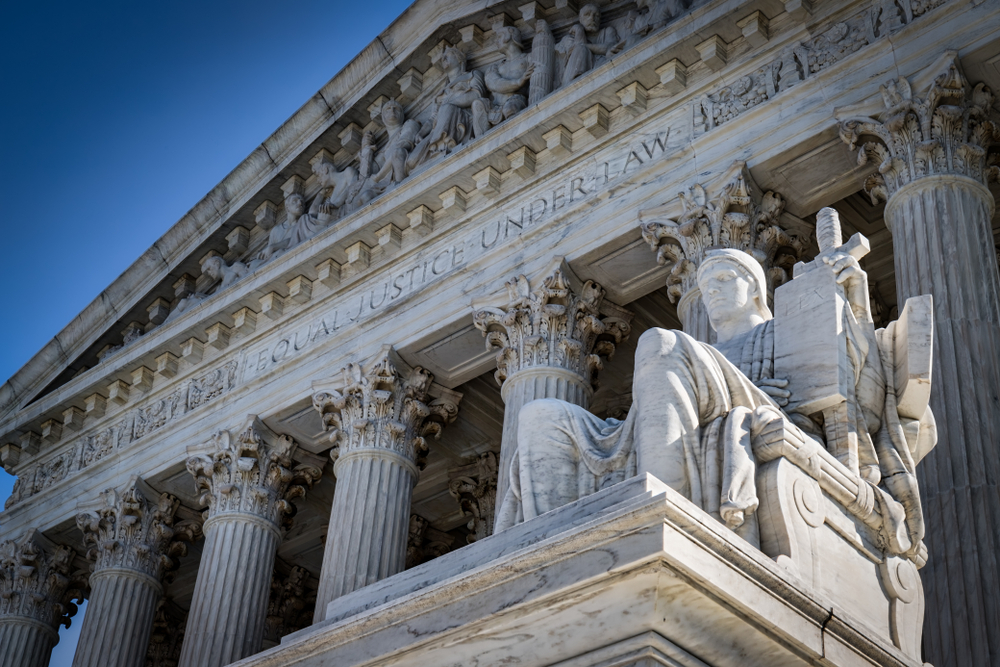
Donald Trump nominated new Justices who many on the right thought would anchor the Supreme Court for decades.
All three broke with him this year – on tariffs, on birthright citizenship, on the Federal Reserve – but never as one bloc.
Now Trump is telling Time exactly how he feels about the three of them.
Trump Says the Quiet Part Out Loud
Asked directly whether he regrets nominating Neil Gorsuch, Brett Kavanaugh, and Amy Coney Barrett, Trump did not dodge.
"What can I do? I put them in," he told Time, in remarks first flagged by Just the News.
He went further, putting it in terms no president usually says about the people he nominated.
"I gave them the position of a lifetime, and they vote against me often," Trump said. "They vote for me too."
That is not a politician spinning a loss.
That is a sitting president keeping score on the people he nominated, out loud.
Gursuch and Kavanaugh have been far better than Barrett in most conservatives’ eyes.
But none of them have proven to be as reliable as Justices Clarence Thomas and Sam Alito.
Three Rulings That Set Off the Frustration
The tariff case started it.
On February 20, 2026, a 6-3 Supreme Court ruling struck down Trump's emergency tariffs, finding he had exceeded his authority under the International Emergency Economic Powers Act.
Gorsuch and Barrett joined Chief Justice Roberts in the majority against him.
Kavanaugh dissented and sided with the president.
Then came June, and the birthright citizenship fight.
The Court rejected Trump's attempt to limit automatic citizenship for children born on U.S. soil.
Barrett joined the majority striking the restriction down.
Kavanaugh reached the same result against Trump through a separate, narrower opinion.
Gorsuch broke the other way this time, dissenting in Trump's favor.
Weeks later, a 5-4 Court blocked Trump's bid to remove Federal Reserve Governor Lisa Cook, a fight Trump had framed as a test of presidential control over monetary policy.
This time it was Kavanaugh who joined the majority against him, while Gorsuch and Barrett dissented on Trump's side.
Three major defeats in a single year, and each of Trump's three nominees took a turn delivering one.
For a president who has repeatedly pushed the outer edges of executive power this term, watching the men he nominated hand him defeats – never the same pair twice – stings in a way losing to Democratic-appointed judges never could.
The Record Those Three Justices Actually Built
Here is where the story gets complicated for anyone looking for a simple villain.
Gorsuch, Kavanaugh, and Barrett are the same three votes that helped overturn Roe v. Wade.
They expanded gun rights under the Second Amendment.
They rolled back race-based affirmative action in college admissions.
They gutted the Chevron doctrine that let unelected bureaucrats write their own rules for decades.
Conservatives pointed to exactly those rulings for years as proof the Federalist Society's judicial-selection process worked.
Trump is not wrong that his picks broke with him on three consequential cases this year.
He is leaving out that the same three picks delivered some of the biggest conservative legal victories in a generation.
What Trump Is Actually Getting At
Trump's complaint is not really about Gorsuch, Kavanaugh, and Barrett turning into secret liberals.
It is a problem conservatives have wrestled with since Dwight Eisenhower appointed Earl Warren and reportedly later called it the biggest mistake of his presidency.
Eisenhower was not alone, either.
George H.W. Bush's pick of David Souter turned into one of the most infamous surprises in modern judicial history.
Souter drifted so far left that "no more Souters" became a rallying cry for the conservative legal movement.
That movement eventually built the Federalist Society pipeline Trump used to pick Gorsuch, Kavanaugh, and Barrett in the first place.
A justice takes an oath to the Constitution, not to the man who nominated them.
That distance is a feature of the design, not a flaw Trump invented.
Where Trump has a real point is on the tariff and Federal Reserve cases – both turned on genuine, unsettled questions about how far executive power extends, and his nominees simply read the law narrower than the White House wanted.
That is a legitimate fight over separation of powers, not proof his justices went rogue, and Trump's frustration with the outcome is earned.
His instincts on picking conservative judges were sound, and the record proves it.
Gorsuch, Kavanaugh, and Barrett delivered the end of Roe, the biggest expansion of gun rights in a generation, and the gutting of the administrative state that has been a defining goal of Trump's second term.
What this year really exposed is how a handful of advisors and legal theorists steering the tariff and Fed-removal strategy misjudged how far even a sympathetic conservative Court would let executive power stretch.
That is a staffing and strategy problem, not a loyalty problem – and it is a much easier one for Trump to fix than the one Eisenhower or Bush faced with Earl Warren and David Souter.
Sources:
- Ben Whedon, "Trump regrets his three Supreme Court nominations," Just the News, October 1, 2026.
- "Trump says he regrets nominating Gorsuch, Kavanaugh, and Barrett," The Hill, October 2026.
- "What Trump Has Built," Time, October 2026.
- "Supreme Court Strikes Down IEEPA Tariffs – What Now?," Skadden, February 20, 2026.
- Staff, "Supreme Court rules Trump cannot fire Fed Governor Lisa Cook for now," CNBC, June 29, 2026.
- SCOTUSblog, "Breaking down the birthright citizenship decision," SCOTUSblog, June 2026.
Related posts:

 JD Vance Says Everything After He Was Asked About Backing Ted Cruz for President
 From Faith to Guns and Oil Money a Three Front SCOTUS Fight Looms
 The Ninth Circuit Just Abandoned a Washington Teen Girl Over Wrestling Warning