
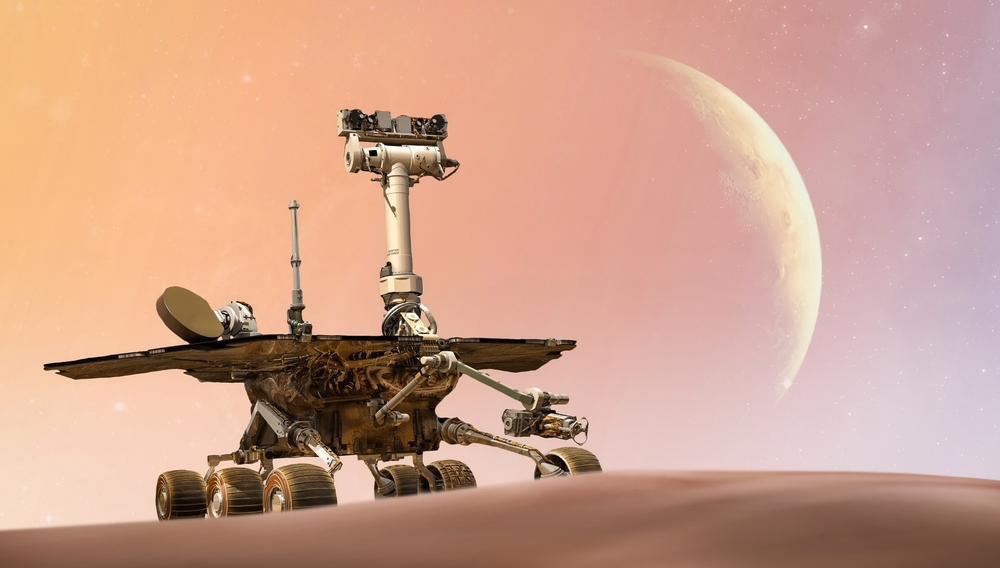
NASA's Curiosity rover spotted bizarre chip-shaped crystals buried in Martian rock.
Curiosity has rolled across Mars for more than fourteen years, longer than any rover before it.
Now the space agency is racing to figure out what those crystals actually are.
Curiosity Found Chip-Shaped Crystals Buried in a Site Called Nazca
NASA scientists are staring at something they have never fully explained.
Mission scientist William Farrand of the Space Science Institute described bedrock at a drill site named Nazca containing what he called "disk-shaped, or in a liberal interpretation, potato chip shaped" crystal forms.
Curiosity's camera caught the formations in close-up on November 7, 2026, lit by onboard white-light and ultraviolet lamps built to reveal detail no sunlight on Mars could show.
The rover aimed its rock-vaporizing laser at three separate targets nicknamed Colca, Ahi Veremos and Bermejo to read their chemical signatures.
A drilled sample from the site went straight into the rover's onboard chemistry lab for a deeper look.
Nearby, Curiosity photographed dark mineral lenses tucked beneath a ridge called Mishe Mokwa and a cluster of rock below a ridge called Cordillera.
NASA's own stated goal is blunt: "to better characterize these chip-shaped features."
Translation: nobody at the space agency currently knows what carved potato-chip shapes into Martian stone.
The laser readings and the chemistry lab results are still being compared against each other back on Earth, a process that takes weeks even when the rover itself finishes its work in a single Martian day.
Curiosity did not stop to wait on the answer.
In the same stretch of work, it photographed Phobos crossing in front of the sun and ran a separate survey hunting for dust devils on the horizon.
Mars Scientists Have Chased Mysterious Crystals Since the Rover's First Decade
This is not the first time Curiosity has stumbled onto something nobody predicted.
Back in 2013, the rover found a mineral vein cutting through Martian rock that NASA scientists said water had almost certainly deposited billions of years ago.
Two years later, Curiosity rolled through a network of crisscrossing mineral veins so dense that NASA nicknamed the whole site Garden City.
JPL researchers have photographed tiny crystal shapes embedded in Martian bedrock for more than a decade now, each one a fresh clue about water that once moved across a planet that is bone dry today.
The potato chip formations are simply the newest entry in that running list, and so far the strangest.
Curiosity was built for a two-year mission.
It is still working, still drilling and still finding things nobody back on Earth anticipated, more than fourteen years later.
Every one of those earlier discoveries forced scientists to rewrite what they thought they knew about early Mars.
The mineral veins proved liquid water once flowed through solid rock.
The crystal clusters at Garden City proved that water came and went in distinct, repeated episodes, not a single ancient flood.
Nobody yet knows what the potato chip crystals will force scientists to rewrite, but the track record says it will be something.
A Fourteen Year Old Rover Is Still Outworking a Billion Dollar Program
A separate NASA program spanned more than a decade and billions of dollars, all to design a robotic mission that would fly Martian rock samples back to Earth.
An independent review board eventually concluded the plan was not realistic on the timeline or the budget it had been given, with cost estimates climbing past eleven billion dollars and a return date slipping toward the 2040s.
Office of Management and Budget Director Russ Vought's budget proposal zeroed out that sample-return program entirely rather than keep feeding a mission outside reviewers had already called unworkable.
Curiosity never got the memo.
It is still parked on the surface of Mars, drilling into bedrock nobody has ever touched, handing scientists new mysteries for a fraction of what Washington was prepared to spend chasing rocks that were never going to make it home on schedule anyway.
China is racing to land a sample-return mission and bring Martian soil to Earth by 2031, hoping to beat the United States to a milestone no nation has ever claimed.
A rover America launched in November 2011, running on a nuclear battery and a mission clock nobody expected to still be ticking, is still finding things on Mars that China's newer program has not even reached yet.
That is the real story underneath the potato chips.
American hardware, built once and flown more than a decade ago, is still out-producing a newer, better-funded foreign program racing to catch up.
Sources:
- Andrea Margolis, "Curiosity Rover Studies Odd Potato Chip Formations on Mars, NASA Says," Fox News, November 17, 2026.
- Alexandra Myers, "NASA Rover Uncovers Bizarre Potato Chip Formations on Mars," Fox Weather, November 17, 2026.
- William Farrand, "Sols 5063-5069: Rocks and Chips," NASA Curiosity Mission Blog, November 11, 2026.
- NASA Jet Propulsion Laboratory, "NASA's Curiosity Eyes Prominent Mineral Veins on Mars," NASA Jet Propulsion Laboratory, 2013.
- Physics World, "NASA's Mars Sample Return Mission Slammed by Independent Review Panel," Physics World, 2024.
- Marcia Smith, "Isaacman's Golden Age of Science and Discovery on Shaky Ground," SpacePolicyOnline.com, April 11, 2025.
Related posts:

 Two Tribes Dragged Washington to Court Over an Eagle Permit It Already Buried Once
 Steve Hilton Showed Up On Fox News Wearing Xavier Becerra’s Face and a Price Tag
 Donald Trump Jr Stacked Russell Brand Against Grooming Gang Sentences and Britain Has No Answer