
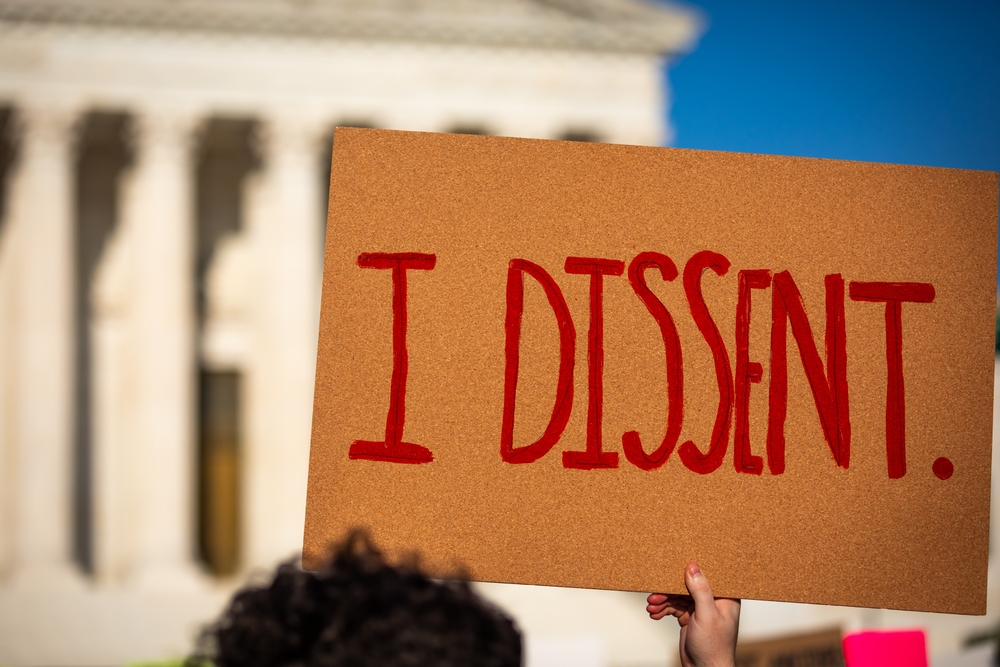
The Supreme Court just gutted a stolen gun conviction because the defendant was Black.
And seven justices – including every so-called conservative except Clarence Thomas – looked the other way.
Now Samuel Alito is on record warning that your local cop just got handed a race-based guessing game with no rulebook.
The DC Court That Rewrote the Constitution
Here's what happened in Washington in 2020.
Officers from DC's Gun Recovery Unit approached a group of men on a sidewalk in an area with an uptick in shootings.
One officer asked Donte Carter if he was carrying a weapon.
Carter lied and said no.
Officers asked him to hike up his pants.
There was an L-shaped bulge.
The bulge was a .40-caliber pistol – stolen from an FBI agent's vehicle in Georgetown.
Carter was arrested and hit with eight firearm-related charges.
The DC Court of Appeals then threw out the conviction entirely.
Not because Carter was innocent.
Not because the officers acted improperly.
But because Carter was Black – and therefore, the court ruled, the encounter automatically became an illegal seizure before officers even had reasonable suspicion.
The DC court cited scholarship claiming that Black men are "especially distrustful of law enforcement" and therefore "less likely" to terminate a police encounter than other people.
That analysis – treating Carter's race as a legal factor that changed whether he was free to walk away – is what Alito called a constitutional catastrophe.
What Alito Actually Said
The Court said no.
Seven justices – including Roberts, Kavanaugh, and Barrett – refused to even hear the case.
Alito, joined by Thomas, wrote a dissent that belongs in a time capsule.
"Under the test, officers will need to quickly assess a person's race," Alito wrote, "and if officers and courts must craft special rules for black persons, what about dark-skinned Latinos, other Latinos, and members of other minority groups?"
He didn't stop there.
"We have said that our 'Constitution is color-blind,'" Alito wrote, citing the 2023 ruling that killed race-conscious admissions at Harvard and UNC.
The Constitution "almost never" allows government actors to treat people differently based on race.
The DC ruling flips that principle completely.
One Rule for Everyone Until Now
The legal standard for whether someone was seized by police has always been the same for every American.
United States v. Mendenhall established the "free to leave" test: would a reasonable person feel they were not free to end the encounter?
That test was objective.
It applied to everyone equally – exactly as the color-blind Constitution demands.
The DC Court of Appeals blew up decades of settled law by inserting a racial variable directly into that test.
Now the question in Washington DC isn't "would a reasonable person feel free to leave?"
The question is "would a reasonable Black man feel free to leave?" – and the answer is automatically different.
Alito pointed out exactly where that logic leads.
"It is dangerous to allow an individual to be treated differently based on statistics, studies, or expert testimony that purports to show that members of the racial or ethnic group to which he belongs are more likely to act in a certain way," he wrote.
That sentence is a direct shot at the DC court's reliance on academic studies about police distrust in Black communities.
Feelings are not the Fourth Amendment.
The Cop in the Street Just Lost
Every officer working DC now has to make a split-second racial calculation before asking a single question.
Approach a Black man and ask if he's carrying? You'd better have had reasonable suspicion already – because the DC court just decided he was seized the moment you asked.
Approach a white man and ask the same question? Different standard.
That's not policing.
That's a lawsuit machine running 24 hours a day.
The Trump administration said it best in its petition: the DC ruling "puts officers in the untenable and unworkable position of needing to rely on racial stereotyping in order to assess the legality of their conduct."
The Supreme Court read that argument, passed on the case three conferences in a row – June 4, June 11, June 18 – and finally let it die on June 22.
According to the government's own cert petition, every other federal circuit court that examined this question declined to make the reasonable-person test race-specific.
DC went there anyway.
And now SCOTUS is letting them stay.
What Alito's Dissent Actually Means
Dissents from cert denials are rare.
Alito didn't write this one because he lost a vote.
He wrote it because he's signaling exactly what comes next.
"Perhaps the DCCA's test has legitimate justifications," he wrote – which is lawyer-speak for "I don't think it does" – "In any event, it is important, and it warrants this Court's review."
That's an invitation.
The next time a circuit court adopts a race-specific reasonable-person standard – or the next time a circuit court explicitly rejects what DC did – there's a circuit split on record.
And circuit splits are how cases get to the Supreme Court.
The man who lied to officers and was carrying a stolen FBI agent's gun is walking free today.
But Alito just put a timer on this.
Sources:
- Fox News Staff, "Cops could be forced into race-based guessing game after Supreme Court move, Thomas joins dissent," Fox News, June 22, 2026.
- Shawn Fleetwood, "Alito, Thomas Scold SCOTUS For Not Enforcing 'Colorblind' Policing," The Federalist, June 22, 2026.
- John Malcolm, "The Supreme Court Slaps the D.C. Court of Appeals," The Heritage Foundation, May 11, 2026.
- SCOTUSblog, "United States v. Carter (25-885)," SCOTUSblog, June 22, 2026.
Related posts:

 Usha Vance Has Two Former Bosses on the Supreme Court and What She Said About Their Safety Stopped the Room
 Zelenskyy Just Found a New Way to Cash In on the Same Soldiers Americans Paid For
 Trump Honored the 13 Americans Killed in Operation Epic Fury at Arlington and Every Single One of Them Deserves to Be Known by Name