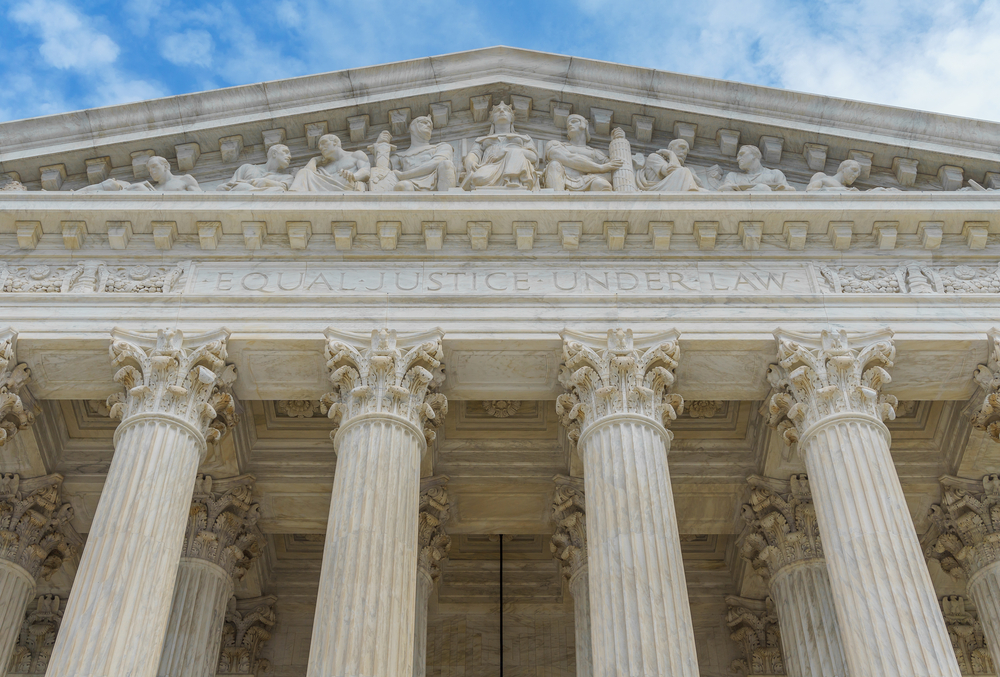
Federal courts have spent years forcing Alabama to sort its own citizens by race when drawing congressional maps.
Today, Alabama AG Steve Marshall told them that game is finished.
And he's got a fresh Supreme Court ruling that just made his case nearly impossible to beat.
Two Trump Judges Just Sided With the Left Against Alabama
The three-judge panel that blocked Alabama's map today included two judges appointed by President Trump.
They still ruled against the state.
The panel was responding to a May 11 Supreme Court order that vacated their previous ruling and sent the case back for reconsideration in light of Louisiana v. Callais – the April 2026 decision gutting race-based redistricting claims.
The panel looked at Callais, looked at Alabama's map, and blocked it anyway.
Their position: a pre-Callais finding that Alabama intentionally discriminated against Black voters remains valid regardless of how the Supreme Court changed the rules.
"Ultimately, we cannot see our way clear to requiring Alabamians to cast their votes in the 2026 elections under a districting plan tainted by intentional race-based discrimination," the panel wrote.
Marshall fired back within hours.
"I am disappointed, but not at all surprised, that the three-judge panel has again struck down Alabama's blandly unobjectionable congressional map that has been in place for decades," he said.
"I find nothing in the U.S. Supreme Court's vacatur order of May 11 that would provide a basis for this outcome; thus, we will immediately appeal this decision to the Supreme Court."
Then he said the quiet part out loud.
"In my mind, it is not a matter of whether we win this case, only when."
https://x.com/EricLDaugh/status/2059340064174322093“>https://x.com/EricLDaugh/status/2059340064174322093
Alabama Has Been Fighting This Since 2021
This fight didn't start today.
Alabama redrew its congressional map after the 2020 census, producing a 6-1 Republican district arrangement.
Federal courts immediately went to war with it.
In Allen v. Milligan, the Supreme Court ruled 5-4 in 2023 that the map likely violated Section 2 of the Voting Rights Act by limiting Black voters to a single district out of seven, despite Black residents making up 27% of the state's population.
Alabama redrew the map in 2023.
Courts blocked that one too.
For the 2024 elections, a court-appointed special master drew Alabama's congressional maps – not the legislature the voters elected.
Alabama sent two Democrats to Congress that cycle – the first time since 2008.
Then Callais changed the rules.
The Supreme Court's April 2026 ruling made it dramatically harder to bring redistricting claims, requiring proof of intentional discrimination rather than just discriminatory effect.
The 6-3 Republican majority sent Alabama's case back down for a second look.
The panel said it didn't matter.
The Flaw the Supreme Court Will Have to Answer
Marshall's appeal rests on a precise legal problem the Supreme Court left unresolved on May 11.
When the Republican-appointed majority vacated the panel's earlier ruling and sent the case back, it offered no guidance on how Callais should interact with a pre-existing intentional discrimination finding built under the old standard.
The panel filled that silence by ruling its old finding survived unchanged.
"Alabama cannot use Callais to legitimize its pre-Callais decision to double down on the discriminatory vote dilution that we and the Supreme Court found," the panel wrote.
Marshall's counter is straightforward: a finding built on a discarded legal framework cannot simply be carried forward as if the framework never changed.
That unanswered question is now the centerpiece of his appeal.
One House Seat and the 2026 Midterms
The stakes are concrete.
Alabama's preferred 6-1 map eliminates one of the two majority-Black districts the court imposed for 2024.
That second court-drawn district elected Democrat Shomari Figures in 2024.
Republicans flipping it back to red means one more seat toward keeping the House majority in November.
Marshall has been explicit that his ultimate goal goes further than a 6-1 map – he wants Alabama in position to draw a 7-0 Republican congressional delegation using race-neutral principles.
That's where Callais points if the Supreme Court follows its own logic all the way down.
The panel blocking Alabama is betting the Court stops short.
Marshall already told you what he thinks happens next.
"It is not a matter of whether we win this case, only when."
Sources:
- Staff, "Federal Court Blocks Alabama from Using GOP-Drawn Congressional Map," NBC News, May 26, 2026.
- Staff, "Court Blocks Alabama Redistricting Map: Why Case Will Head to Supreme Court," Newsweek, May 26, 2026.
- Staff, "Alabama Map Fight Erupts Again As Federal Panel Defies SCOTUS Momentum," RedState, May 26, 2026.
- M.D. Kittle, "SCOTUS Clears Way for Alabama to Scrap Race-Based Districts," The Federalist, May 12, 2026.
- Alabama Attorney General's Office, "Attorney General Marshall Releases Statement on Court Ruling in Allen v. Milligan," May 26, 2026.
- Alabama Attorney General's Office, "Attorney General Marshall Fights for Alabama, Asks Supreme Court to Block Race-Based Congressional Map Before May 19 Primary," May 8, 2026.
Related posts:

 Lauren Boebert Just Sounded the Alarm on the Three Democrat Moves That Would Lock Republicans Out Forever
 Karoline Leavitt Just Shared the “Vivi” Photo America Has Been Waiting to See
 Stacey Abrams Sister Just Got One Vicious Rebuke for Hiding Judicial Ethics Violations from Georgia Voters